
Introduction
Most urban cycling projects fail in the same predictable way: they obsess over lanes and ignore everything that happens before and after the ride. That’s exactly where bikesly stands out. It doesn’t try to reinvent cycling. It fixes the parts cities keep neglecting—parking, charging, and daily usability—without turning the experience into a chore.
The real friction in daily cycling isn’t the ride
Ask anyone who cycles regularly in a busy city and they’ll tell you the ride itself is rarely the problem. The issues stack up once you arrive.
You reach your office, but there’s nowhere safe to leave your bike. Or you lock it to a random pole and spend the rest of the day half-expecting it to disappear. If you ride an e-bike, the situation gets worse. Battery anxiety replaces range anxiety. You start planning your day around where you might find a plug.
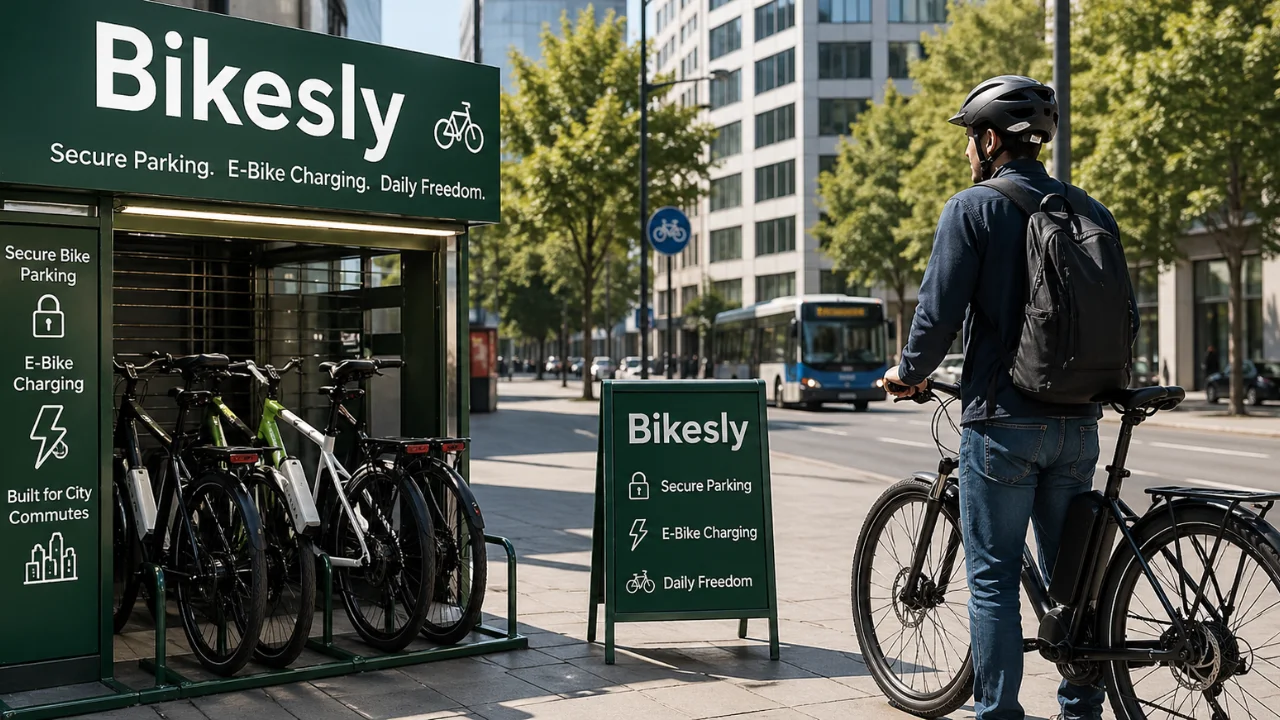
bikesly steps directly into this gap. Instead of adding more lanes or pushing awareness campaigns, it focuses on what happens at the destination. Secure parking and charging are treated as essential, not optional.
That shift sounds small. It isn’t.
Why bikesly feels practical instead of ambitious
A lot of urban mobility ideas sound impressive on paper but fall apart in real life. bikesly avoids that trap by staying grounded in everyday behavior.
It doesn’t ask people to change how they ride. It simply makes the end of the journey easier.
The system revolves around three core elements:
- Dedicated bike parking spaces that are actually secure
- Charging access designed for e-bike users
- A digital layer that handles booking and access without friction
That combination turns cycling from a risk into a routine. And routine is what cities need if they want more people on bikes.
Security isn’t a feature, it’s the baseline
Bike theft is one of the fastest ways to push people back into cars. It doesn’t matter how many cycling campaigns exist—if riders don’t trust parking, they won’t commit.
bikesly treats security as non-negotiable. This isn’t just about adding locks or cameras. It’s about controlled access.
When parking is tied to a system—something you unlock digitally, something that tracks usage—you reduce random access. That alone changes behavior. It discourages opportunistic theft and gives riders confidence that their bike will still be there when they return.
Confidence is what keeps someone cycling five days a week instead of once a month.
E-bikes change the rules, and bikesly adapts to that
E-bikes aren’t a niche anymore. They’ve changed commuting patterns in a big way. People travel longer distances, rely less on cars, and expect infrastructure to keep up.
But most cities still treat bikes and e-bikes the same. That’s a mistake.
Charging is the missing layer. Without it, e-bike adoption hits a ceiling. People won’t rely on something that can run out of power mid-day with no clear solution.
bikesly builds charging into the system instead of treating it as an afterthought. You don’t hunt for a socket. You don’t carry backup plans. You know where you’ll charge before you even start your ride.
That predictability matters more than speed or range.
The role of the app isn’t flashy—it’s functional
Plenty of mobility platforms lean too hard on apps, turning simple actions into multi-step processes. bikesly avoids that by keeping the digital layer focused.
You use it to:
- Reserve a parking spot
- Access the facility
- Manage your usage
That’s it.
There’s no unnecessary complexity, no overload of features. The app supports the physical system instead of trying to replace it.
This balance is rare. Most systems either go fully physical and become inefficient, or fully digital and become frustrating. bikesly sits in the middle.
Where bikesly fits into real urban environments
The strength of bikesly isn’t just in what it offers—it’s where it can be placed.
It works best in locations where cycling demand already exists but infrastructure lags behind:
- Office buildings with limited bike storage
- Transit hubs where riders switch modes
- Universities with dense daily traffic
- Commercial areas with short-term parking needs
In these spaces, bikesly doesn’t need to convince people to cycle. It simply removes the reasons they hesitate.
That’s a much easier problem to solve—and a more effective one.
Traditional bike parking is part of the problem
Most existing bike parking setups feel like placeholders. A few metal racks, often exposed, rarely monitored, and almost never designed with long-term use in mind.
They send a message: your bike is your responsibility, not ours.
bikesly flips that message. It treats cycling infrastructure as something worth investing in, not just accommodating.
This difference shows up in usage patterns. When people trust the system, they use it consistently. When they don’t, they look for alternatives—or stop cycling altogether.
The economics behind bikesly make sense
Cycling infrastructure often gets framed as a public cost. That’s part of why it’s underdeveloped.
bikesly introduces a model that can work for both public and private stakeholders.
Businesses can install it to attract employees or customers. Property managers can use it to increase building value. Cities can integrate it into broader transport systems without carrying the entire financial burden.
That flexibility matters. It makes adoption more realistic.
bikesly and the shift toward practical sustainability
Sustainability conversations tend to drift into abstract territory. Targets, policies, long-term visions. All important, but often disconnected from daily life.
bikesly brings the conversation back to ground level.
If someone can ride to work, park securely, charge their bike, and leave without stress—that’s sustainability in action. No campaign needed.
It’s not about convincing people to care. It’s about making the better choice easier.
What bikesly still needs to prove
No system is perfect, and bikesly isn’t exempt from scrutiny.
Scale is the real test. A few well-placed installations can work smoothly, but expanding across entire cities introduces complexity. Maintenance, pricing models, and accessibility all become bigger questions.
There’s also the challenge of integration. bikesly works best when it connects with other parts of the transport network. If it operates in isolation, its impact stays limited.
These aren’t deal-breakers, but they matter. Success depends on how well these issues are handled over time.
Why bikesly stands out in a crowded mobility space
Urban mobility is full of ideas competing for attention. Bike-sharing programs, ride-hailing platforms, electric scooters. Each tries to solve a piece of the puzzle.
bikesly doesn’t compete directly with them. It supports them.
It focuses on infrastructure—the part that often gets ignored because it’s less visible. But infrastructure is what determines whether any mobility solution actually works.
Without reliable parking and charging, even the best systems struggle.
That’s where bikesly earns its place.
The takeaway most cities miss
Cities often chase visibility. New lanes, pilot programs, flashy launches. These look good in reports but don’t always change behavior.
bikesly works in the background. It improves the experience quietly, where it matters most.
That’s why it has potential.
Not because it’s revolutionary, but because it’s realistic.
And right now, realism is exactly what urban cycling needs.
FAQs
1. Is bikesly only useful for large cities?
Not really. It works best where cycling demand exists, but that includes mid-sized cities and even campuses or business districts.
2. Can bikesly replace traditional bike racks completely?
In high-traffic areas, it can. In quieter zones, simpler racks might still make sense. It depends on usage patterns.
3. Do riders need to pay to use bikesly systems?
That depends on how it’s implemented. Some setups may be free through employers or property owners, while others could involve small fees.
4. How reliable is bikesly for daily commuters?
Its value comes from consistency. If maintained properly, it becomes part of a predictable routine, which is what commuters need.
5. Does bikesly support all types of bikes?
Most systems are designed to accommodate standard bikes and e-bikes, but exact compatibility can vary by installation.
You May Also Read: Ottans: Deep Influence on Power, Culture and Modern Living Systems